Why Dressing on Autopilot Is the Smartest Thing You Can Do

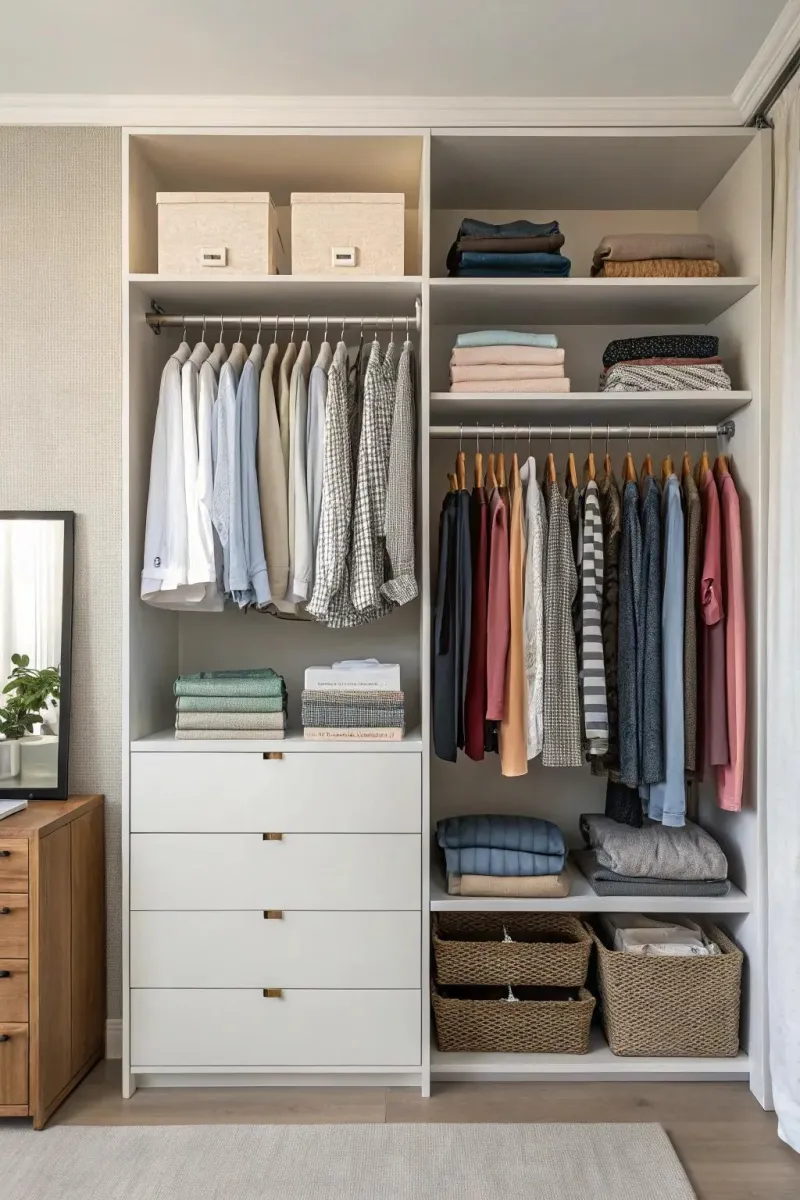
Photo: minimalist wardrobe flat lay neutral tones organized closet, via s.alicdn.com
Every morning, before you've had your coffee, you're already making decisions. What to eat. What to check first on your phone. Whether the meeting at 9 actually needed to be a meeting. And somewhere in the middle of all that, you're standing in front of your closet, staring into it like it owes you something.
Here's the thing: it doesn't. And the sooner you stop expecting it to, the better your days get.
The Science of Decision Fatigue (And Why Your Closet Is Draining You)
Psychologists have a name for what happens when you burn through too many small choices early in the day — decision fatigue. The research, popularized in part by studies on judges, executives, and yes, even shoppers, points to the same conclusion: the more decisions you make, the worse you get at making them. Quality degrades. Willpower thins out. By afternoon, you're either defaulting to whatever's easiest or avoiding decisions altogether.
Your wardrobe is one of the most underestimated drains on that daily budget. Not because fashion is frivolous, but because most people treat it like a problem to solve fresh every single morning rather than a system they've already figured out.
High performers across industries have been quietly exploiting this for years. Barack Obama famously limited himself to gray and navy suits during his presidency, citing the need to reduce trivial decisions so he could focus on ones that actually mattered. Steve Jobs had his turtleneck. Anna Wintour has her sunglasses and A-line skirt. Mark Zuckerberg has his gray t-shirt. These aren't people who stopped caring about their appearance — they cared enough to make a decision once and let it run on autopilot after that.
Constraints Don't Limit You. They Focus You.
There's a counterintuitive truth buried in creative fields: constraints tend to produce better work than total freedom. Give a designer unlimited options and they'll often freeze. Give them a tight brief, a limited color palette, a strict format — and suddenly something interesting emerges.
The same logic applies to your closet. When you narrow down what you wear to a consistent formula — a specific cut of pant, a reliable layer, a handful of colors that always work together — you're not limiting your self-expression. You're concentrating it. Every piece you reach for carries more intentionality. You stop wearing things by accident and start wearing them on purpose.
This is the quiet power behind what people in style circles call a "personal uniform." It's not a costume. It's a signature. The difference between someone who always looks put-together and someone who sometimes does usually isn't talent or money — it's a system.
What a Personal Uniform Actually Looks Like
A uniform doesn't mean wearing the exact same outfit on repeat (though it can, and plenty of people do). More practically, it means developing a consistent formula — a set of variables that you've already tested and know work for your body, your lifestyle, and the way you want to show up.
Maybe yours is a straight-leg pant, a relaxed crew neck, and clean leather sneakers. Maybe it's dark jeans, a fitted tee, and one good jacket that handles every occasion from coffee to a casual Friday presentation. The specifics matter less than the consistency.
What you're building is a repeatable answer to a question you no longer want to ask every morning. And once that answer is locked in, you'd be surprised how much mental real estate opens up.
The Confidence Dividend
There's another layer here that doesn't get talked about enough: when you stop second-guessing what you're wearing, you stop second-guessing yourself in general — at least for a few crucial hours.
Confidence isn't just a feeling. It's a resource. And it compounds. Walking into a room knowing you look exactly the way you intended to look — not hoping you do, not wondering if you should have worn the other thing — frees up attention that you can direct outward. You stop managing your own appearance in your head and start actually being present.
That shift is subtle, but people notice it. Not because your outfit changed, but because you did.
Getting There Without Overhauling Everything
Building a personal uniform doesn't require a dramatic closet purge or a major shopping trip. It starts with observation. Pay attention to what you actually reach for. Notice the pieces you skip over day after day. Ask yourself what you'd wear if every option in your closet were equally clean and pressed — that answer tells you more about your real style than any quiz or mood board ever will.
From there, it's about editing. Remove the outliers. Double down on what works. Buy better versions of the things you already love.
The goal isn't a smaller closet. It's a more deliberate one. One where every item earns its place, where nothing is filler, and where getting dressed in the morning stops being a low-stakes battle of willpower and starts being the simplest part of your day.
That's the uniform effect. Not restriction — release.