Stop Doing the Math Wrong: Why Cheap Clothes Are the Most Expensive Ones You Own
Let's do some honest accounting.
You bought a pair of jeans last spring for $38. They fit okay, washed a little rough, and started fraying at the hem by August. You replaced them in October—another $38, maybe $42 this time. That's $80 in jeans in about seven months. Meanwhile, your friend spent $160 on a single pair, wore them all year, and is still wearing them now.
Who spent more on jeans?
This is the math that fast fashion doesn't want you to do. And most people never do it, because the sticker price feels like the whole story. It isn't.
The Cost-Per-Wear Formula (And Why It Changes Everything)
Cost-per-wear is the simplest financial tool you're probably not using for your wardrobe. The formula is exactly what it sounds like:
Cost-per-wear = Total item cost ÷ Number of times worn
A $200 jacket you wear 150 times over five years costs you $1.33 per wear. A $60 jacket you wear 20 times before it pills, fades, or falls apart costs you $3.00 per wear—more than twice as much, for an inferior experience the entire time.
Plug in your own numbers and the pattern holds almost universally: the cheaper item is rarely the better deal.
This isn't a trick to justify luxury spending. It's a framework for making smarter decisions with whatever budget you're working with. And once you start seeing your wardrobe through this lens, impulse purchases start looking a lot less attractive.
Case Study: The T-Shirt Math
Let's get specific. Say you're a person who wears plain crewneck tees constantly—weekend wear, under flannels, around the house, casual Fridays. You go through about three a year because they shrink, fade, or lose their shape.
Option A: Three $15 tees per year, replaced annually. Over five years, that's $225 and roughly 15 tees in a landfill.
Option B: Two $55 tees that hold their shape, maintain color, and last three-plus years each. Over five years, that's around $110—and maybe four tees total.
Same basic garment. Half the cost. A fraction of the waste. And every time you put on Option B, it fits right, feels right, and looks right—which is not nothing.
This is where quality stops being a luxury argument and starts being a math argument.
The Environmental ROI Nobody Talks About
The financial case for buying better is compelling enough on its own. But there's a second ledger worth keeping.
The fashion industry is one of the most resource-intensive on the planet. Producing a single cotton t-shirt requires roughly 700 gallons of water. Synthetic fabrics shed microplastics with every wash. And the fast fashion model—built on cheap, disposable garments—is designed to accelerate consumption, not minimize it.
When you buy fewer, better things, you're opting out of that cycle in a meaningful way. Not in a way that requires a manifesto or a lifestyle overhaul—just in a way that says: I'd rather have two things I love than ten things I tolerate.
The wardrobe that costs you less money over time also tends to be the one with a lighter footprint. That's not a coincidence. Durability and sustainability are almost always the same design feature.
The Investment Tier vs. The Thrift Tier: How to Split Your Spending
Here's the practical part. Not everything in your wardrobe deserves a premium price tag, and pretending otherwise is just as financially irresponsible as buying everything cheap.
The key is knowing where quality actually shows up in your life—and spending accordingly.
Invest more in:
- Foundational pieces you wear constantly (quality basics, well-cut trousers, reliable outerwear)
- Anything that touches your body all day (shoes, denim, base layers)
- Items with high visibility that anchor your overall look
- Pieces built to last structurally—stitching, hardware, fabric weight all matter
Spend less on:
- Trend-driven items with a short shelf life
- Pieces for very specific occasions you'll wear once or twice
- Anything you're buying experimentally—a new color, a new silhouette you're not sure about yet
- Layering items that stay mostly hidden
This isn't about being precious with your money. It's about being strategic. Thrift stores, secondhand platforms, and affordable basics all have a role to play. The goal is a wardrobe where every dollar you spent is working as hard as the clothes themselves.
What Real Wardrobes Look Like When the Math Works
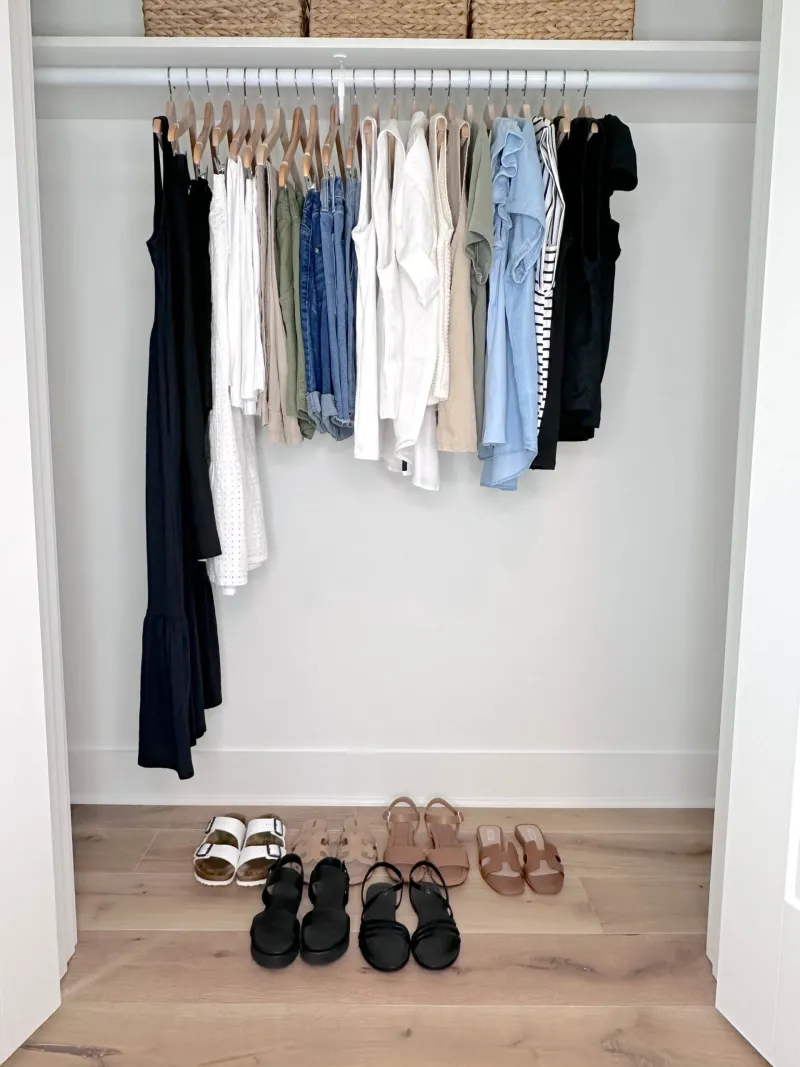
Consider someone rebuilding their closet from scratch with $600. The impulse is to maximize quantity—stretch the budget across as many pieces as possible. But a smarter allocation might look like this:
- One excellent pair of dark jeans: $140
- Two high-quality plain tees in neutral colors: $90
- One versatile, well-constructed overshirt or light jacket: $150
- One pair of quality leather or leather-alternative shoes: $130
- Two pairs of chinos or trousers in complementary tones: $90
That's eleven pieces, total. But they're eleven pieces that work together, hold up over time, and cost-per-wear their way into genuine value within the first year of regular use.
Compare that to $600 spread across 30 fast fashion items with a median lifespan of eight months. The numbers don't lie.
Fewer Things, More Meaning
There's a reason OSO Apparel's whole ethos lands on wear less, mean more. It's not a slogan built on deprivation—it's built on intention. The wardrobe that's working for you isn't the biggest one. It's the one where everything earns its place, where you know the cost, the value, and the longevity of what you own.
Stop buying cheap and calling it smart. Start doing the actual math. The most expensive clothes you own are probably the ones that cost you the least at checkout.